
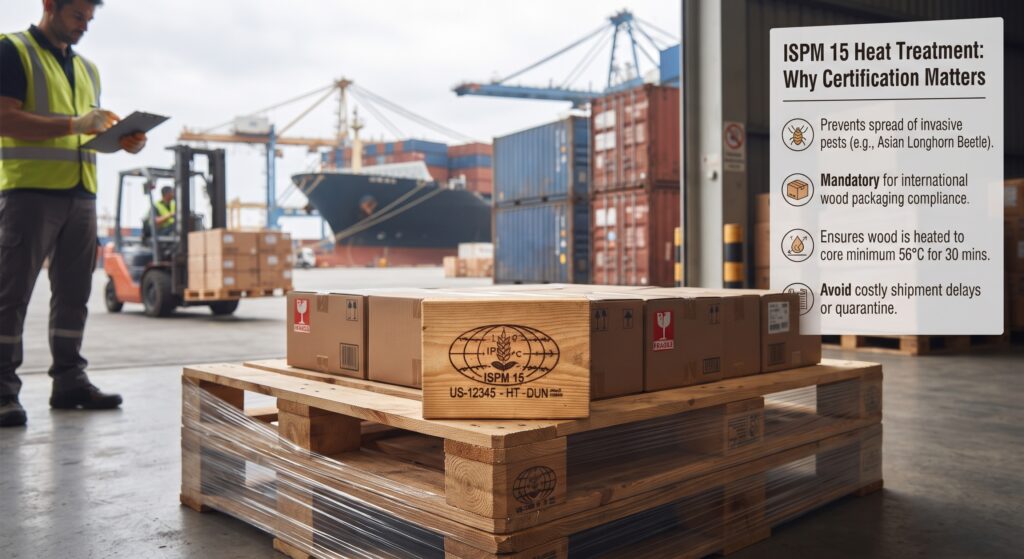
A single unmarked wooden pallet can halt an entire shipping container at a foreign port. It can trigger re-treatment fees, cargo delays, or outright rejection and destruction of goods. The reason is not the cargo itself, but the raw wood beneath it. ISPM 15 heat treatment exists to eliminate that risk, and certification is the only proof that the treatment actually happened.
The Biological Threat Hidden in Plain Wood
Wood packaging material—pallets, crates, dunnage, spools, and boxes—is manufactured from raw timber. That timber can harbor bark beetles, wood-boring insects, fungi, and nematodes that feed on trees for food and shelter . When untreated pallets travel across borders, these organisms travel with them. The pine wood nematode, for example, has devastated pine forests in Portugal and Japan after arriving in imported wood . The Asian longhorned beetle has similarly established populations far from its native range through wood packaging pathways.
The scale of the problem is enormous. Roughly 80 percent of all consignments moving in international trade include some form of wood packaging material . A pallet may circulate for years, passing through dozens of countries before being discarded. By the time an infestation is detected, tracing the pallet back to its origin is often impossible. Country-specific import rules for individual pallets are unworkable at this scale, which is why the International Plant Protection Convention adopted a single harmonized standard: ISPM 15 .
What Heat Treatment Actually Requires
ISPM 15 recognizes several approved treatments, but heat treatment (HT) has become the dominant method worldwide. The technical requirement is precise: the wood must reach a minimum core temperature of 56 degrees Celsius for at least 30 continuous minutes . The key word is “core.” Surface heating is insufficient. The thermal dose must penetrate the thickest part of the wood to ensure that insects and pathogens throughout the material are destroyed.
Treatment typically occurs in purpose-built kilns or heat chambers equipped with temperature sensors placed throughout the load. Proper air circulation is essential to deliver uniform heat across every pallet in a batch . Once the treatment cycle is complete and verified, the wood is marked with the official ISPM 15 stamp.
The mark itself contains critical information. The IPPC logo identifies the standard. A two-letter country code indicates where the wood was treated. A unique registration number identifies the facility. And the letters “HT” confirm that heat treatment was the method used . This stamp is not decorative. It is a legally recognized certification that replaces the need for a separate phytosanitary certificate for the wood packaging itself .
Why the Certification Mark Matters More Than the Treatment
Here is a distinction that many exporters miss: the treatment is invisible, but the mark is evidence. A pallet may have been heat-treated correctly, but without a legible, properly applied mark, an inspector at the destination port has no way to verify that fact. The pallet will be treated as untreated wood.
This is why ISPM 15 compliance depends on using wood from approved and registered treatment providers. In Turkey, for example, regulations specify that heat treatment and marking must be carried out by permitted enterprises, with traceability measures including QR codes in some implementations . In New Zealand, only organizations approved by the Ministry for Primary Industries can apply the registered certification mark . The mark must be durable, non-transferable, and applied to at least two opposite sides of the packaging .
The consequences of a missing or illegible mark are immediate. U.S. Customs and Border Protection states plainly that untreated wood poses a significant risk, and non-compliant wood packaging is subject to refusal, re-export, or destruction . For Pakistani exporters, the Department of Plant Protection enforces similar requirements. Exporters using wooden pallets must ensure every pallet carries a legible ISPM 15 mark from an authorized provider before loading . A treatment certificate for the cargo itself—such as a fumigation certificate for grain—does not substitute for the pallet mark .
The Economics of Non-Compliance
The cost of ISPM 15-certified pallets is a fraction of the cost of a rejected shipment. When a container arrives at a port with unmarked wood packaging, the importer faces several outcomes. The shipment may be held while the wood is re-treated on-site, assuming facilities are available. It may be refused entry entirely and returned to the origin at the exporter’s expense. In the worst case, the packaging is destroyed and the cargo is delayed long enough to miss critical delivery windows.
For perishable goods—mangoes, onions, fresh produce—even a short delay can render the entire consignment worthless. The temperature program for a reefer container does not repair an unmarked pallet . The pallet is either compliant at the moment of inspection or it is not.
There is also a reputational cost. Repeated non-compliance can lead to increased inspection rates for a particular exporter or origin country. The IPPC explicitly notes that because wood packaging circulates for years and is difficult to trace, the only workable system is one in which every treated unit carries a verifiable mark . An exporter who introduces unmarked wood into that system becomes a weak link in an otherwise harmonized chain.
What Is Exempt, and What Is Not?
ISPM 15 does not apply to all wood products. Understanding the exemptions prevents both unnecessary treatment costs and accidental non-compliance. Wood that is 6 millimeters or less in thickness is exempt, as is processed wood such as plywood, particle board, oriented strand board, and veneer that has been created using glue, heat, or pressure . Wine barrels that are heated during manufacture, sawdust, wood wool, and gift boxes made from processed wood are also outside the standard’s scope.
The distinction is between raw solid wood and manufactured wood products. A fibreboard carton is not subject to ISPM 15. The wooden pallet beneath it is. A plastic pallet is outside the rule entirely. A wooden pallet repaired with unmarked boards is non-compliant, even if the original pallet was certified . This last point matters for exporters who reuse and repair pallets: any repaired component must also be treated and marked, or the entire unit loses its compliance status.
The Bottom Line for Exporters
ISPM 15 heat treatment is not a bureaucratic formality. It is a biological security measure with a clear technical standard: 56 degrees Celsius at the core for 30 minutes. The certification mark is the only practical way to prove that the standard was met. Exporters who treat pallets as an afterthought—buying whatever wood is cheapest, reusing unmarked pallets from domestic shipments, or assuming that cargo treatment covers the packaging—are gambling with their shipments.
The safe approach is straightforward. Source wood packaging from suppliers who can demonstrate ISPM 15 compliance. Inspect the mark before loading: it must be legible, it must carry the correct country code and treatment abbreviation, and it must be present on the pallet itself. When in doubt, treat the pallet as a regulated article, because at the border, that is exactly what it is. The cost of a certified pallet is small. The cost of a rejected container is not.